
Servicios de Software
Para Empresas
Productos
Crear Agentes IA
Seguridad
Portafolio
Contratar Desarrolladores
Contratar Desarrolladores

Get Senior Engineers Straight To Your Inbox

Every month we send out our top new engineers in our network who are looking for work, be the first to get informed when top engineers become available

At Slashdev, we connect top-tier software engineers with innovative companies. Our network includes the most talented developers worldwide, carefully vetted to ensure exceptional quality and reliability.
Build With Us
Code Audit for C# .NET, Node.js, and LLM Orchestration/

Patrich
Patrich is a senior software engineer with 15+ years of software engineering and systems engineering experience.
0 Min Read




Code Audit Framework: Exposing Performance, Security, and Scale Gaps
Executives ask for velocity; systems demand discipline. This framework shows how to audit C# .NET application development, Node.js backend development, and LLM orchestration and observability with the rigor of a production readiness review. Apply it quarterly, treat findings as backlog items, and tie each to measurable risk or revenue impact.
Establish an audit baseline
- Define SLOs: p95 latency, error rate, and cost per request/token. Without targets, every fix is subjective.
- Instrument first: OpenTelemetry traces, RED/USE metrics, and structured logs with request IDs across services.
- Capture a two-week trace sample under real traffic. Synthesize gaps via flamegraphs and dependency maps.
Performance hotspots to hunt
For C# .NET application development:
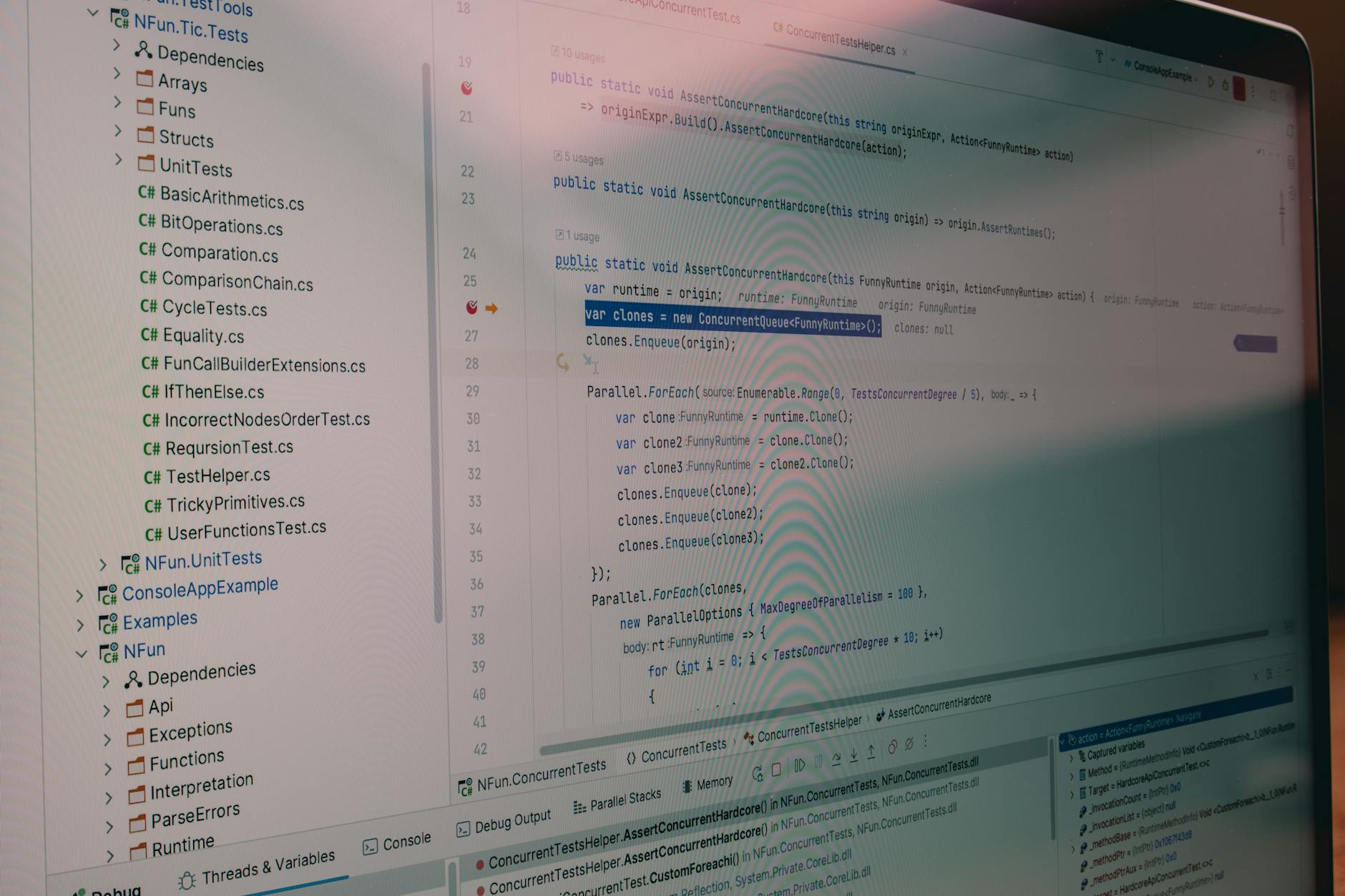
- Use BenchmarkDotNet for micro-benchmarks on hot code paths discovered from traces, not guesswork.
- Replace per-request HttpClient with HttpClientFactory; pool SocketsHttpHandler; verify DNS refresh settings.
- In EF Core, enable compiled queries for high-frequency reads; profile N+1 via Include/AsSplitQuery; watch async streams.
- Eliminate LOH pressure with pooled arrays and Span usage; confirm no accidental boxing in logging paths.
- Measure GC pauses with PerfView; tune Server GC vs Workstation; cap gen2 allocation storms.
For Node.js backend development:

- Run Clinic.js and autocannon; identify event-loop stalls over 50 ms; offload crypto/compression to worker threads.
- Ensure one database client per process with internal pooling; prevent per-request connections.
- Adopt Fastify for lower overhead; use pino async logging; batch logs to avoid fs sync churn.
- Cluster or PM2 only when CPU-bound; pin containers with CPU sets; prefer horizontal pods over overstuffed clusters.
System-wide gains:
- Cache with explicit TTLs and stampede protection; track cache hit rate by keyspace in metrics.
- Add idempotency keys on write endpoints; time-box downstream calls; apply exponential backoff with jitter.
- Run load tests that mirror traffic shape (burstiness, payload mix); validate p95 under 2x expected load.
Security surfaces you cannot ignore
- Threat model by data flow, not by repo. Document trust boundaries, auth contexts, and outbound calls.
- Supply chain: lockfiles reviewed on each release; generate SBOM; verify package signatures; block typosquats.
- .NET specifics: prohibit insecure deserialization; validate Regex with timeouts; use DataProtection APIs for secrets at rest.
- Node specifics: scan for prototype pollution, unsafe eval, unguarded JSON parsing; isolate dev tools from runtime builds.
- Secrets: no env leakage in logs; rotate keys automatically; enforce mTLS for east-west traffic; pin outbound TLS.
- AuthZ: move from role checks in controllers to policy-based authorization; add explicit deny logs with subject, action, resource.
- DAST against staging mirrors; fuzz critical parsers; capture WAF anomaly scores in traces.
Scalability and resilience patterns
- Backpressure at ingress: queue depth, drop policy, or 429 with Retry-After; never infinite buffers.
- Bulkheads: separate pools for read vs write traffic; isolate dependency clients per service.
- Circuit breakers with success thresholds; publish breaker state to metrics and Slack for visibility.
- Database scale: audit slow queries; add covering indexes; consider read replicas or CQRS for report paths; verify pool exhaustion alerts.
- Data growth: partition tables by time or tenant; schedule archival; benchmark compaction windows.
LLM orchestration and observability
- Gateway pattern: centralize providers, prompts, safety, and cost limits; persist request/response envelopes with versioned prompt templates.
- Token budgets: set max tokens per route; enforce retries with decrementing budgets and provider failover.
- Prompt hygiene: E2E tests with red-team prompts; assert refusal rates; scan outputs for PII using classifiers.
- Caching: semantic cache for deterministic prompts; eviction keyed by model, temperature, and template hash.
- Observability: include semantic spans for retrieve, rerank, generate; log token counts, latency, cost, and safety flags per span.
- Drift detection: weekly eval sets with golden answers; alert on BLEU/ROUGE/accuracy deltas beyond thresholds.
Remediation operating model
- Create an “Audit PR” label. Each finding requires a hypothesis, metric, owner, and rollback plan.
- Ship small: one change per deploy behind feature flags; compare baseline vs candidate with canary metrics.
- Quantify wins in dollars: latency cut x conversions; downtime avoided x SLA penalties; token savings x LLM bill.
- Partner smart: when bandwidth is thin, firms like slashdev.io provide vetted remote engineers who can execute changes quickly without sacrificing rigor.
Quick diagnostic checklist
- Do traces cover 95% of routes with database, cache, and external spans?
- Are p95 goals met during failure simulations (dependency 50% errors)?
- Is there a single source of truth for secrets and key rotation events?
- Can you replay a production incident locally from logs and spans within 15 minutes?
- Are LLM prompts, costs, and refusal rates visible per tenant and feature?
- Does every new endpoint document idempotency, rate limits, and SLOs?
The strongest audit culture treats code as a living asset. By making performance, security, and scalability testable-and by embedding LLM orchestration and observability into the same backbone-you replace anxiety with evidence. That is how teams turn ambitious roadmaps into dependable reality.